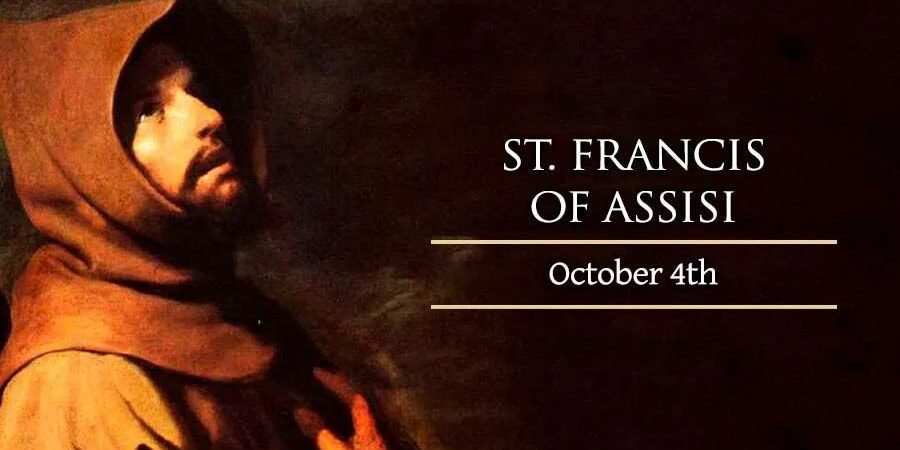
Sunday. October 4, 2026. Saint Francis was born at Assisi, baptized Giovanni (after John the Baptist). His father, Pietro Bernardone, returned from a trip; far from being excited, he was furious. He wanted his son’s name not of a man of God — he wanted a man of business, and he especially wanted a son who would reflect his infatuation with France. So he renamed his son Francesco — which is the equivalent of calling him a Frenchman. Francis enjoyed a very rich, easy life; everyone loved Francis. He was constantly happy, charming, and a born leader. He was so much of a dreamer he did poorly in school; no one minded. In many ways, he was too easy to like. As he grew up, he spent nights in wild parties -falling in love with everything about France. He wanted more than wealth; he wanted to be a noble with the glory and prestige. He got his first chance when Assisi declared war; he joined the troops, mostly of whom were butchered, but he was taken prisoner, chained in a dark dungeon. He never lost his happy manner; after a year, he was ransomed. He was finally among the nobility like he always wanted to be. The experience didn’t change him; he was partying again with much joy. A call for knights gave him a chance for his dream. In a suit of armor and on a horse, he started his journey, but he never got farther than one day’s ride from Assisi. He had a dream in which God told him he had it all wrong and told him to return home, and he did, without ever making it to battle – he was humiliated and called a coward by the village. Francis’ conversion did not happen overnight. God had waited for him for 25 years, and now it was Francis’ turn to wait. He started to spend more time in prayer; he wept for his sins. God’s grace overwhelmed him with joy. One day, while riding through the countryside, Francis came face to face with a leper; he jumped down from his horse and kissed the hand of the leper. When his kiss of peace was returned, Francis was filled with joy. As he rode off, he turned around for a last wave, and saw that the leper had disappeared. He always looked upon it as a test from God…that he had passed. His search for conversion led him to the ancient church at San Damiano. While he was praying there, he heard Christ on the crucifix speak to him, “Francis, repair my church.” Francis assumed this meant the crumbling building he was in. He took fabric from his father’s shop and sold it to get money to repair the church. His father saw this as an act of theft. Pietro dragged Francis before the bishop and, in front of the whole town, demanded that Francis return the money and renounce all rights as his heir.In front of the crowd, he said, “Pietro Bernardone is no longer my father. From now on I can say with complete freedom, ‘Our Father who art in heaven.’” Wearing nothing but castoff rags, he went off into the freezing woods — singing. From then on, Francis had nothing and everything. Francis went back to what he considered God’s call. He begged for stones and rebuilt the San Damiano church with his own hands. Soon he started to preach about returning to God and obedience to the Church. Slowly, companions from all walks of life came to Francis, people who wanted to follow his life of loving. His direction for this life is simply to live by the Gospel. Francis practiced true equality by showing honor, respect, and love to every person. Much has been written about Francis’ love of nature, but his relationship was deeper than that; it was that all God’s creations were part of his brotherhood. The sparrow was as much his brother as the pope. In one famous story, Francis preached to hundreds of birds about being thankful to God for their wonderful clothes, for their independence, and for God’s care. The story tells us the birds stood still as he walked among them, only flying off when he said they could leave.Another famous story involves a wolf that had been eating human beings. Francis intervened when the town wanted to kill the wolf and talked the wolf into never killing again. The wolf became a pet of the townspeople who made sure that he always had plenty to eat.Following the Gospel literally, Francis and his companions went out to preach; listeners were hostile to them in rags trying to talk about God’s love. Soon some people noticed that these barefoot beggars wearing sacks seemed filled with constant joy. They celebrated life.Francis did not try to abolish poverty; he tried to make it holy. When his friars met someone poorer than they, they would eagerly rip off the sleeve of their habit to give to the person.” Possessing something was the death of love, he reasoned; what could you do to a man who owns nothing? His simplicity of life extended to ideas and deeds. He acted from the heart; once he was so sick and exhausted, his companions borrowed a mule for him to ride. When the man who owned the mule recognized Francis, he said, “Try to be as virtuous as everyone thinks you are because many have a lot of confidence in you.” Francis dropped off the mule and knelt before the man to thank him for his advice. When he was in Syria to convert the Moslems, Francis decided to do the simplest thing and go straight to the sultan to make peace. He was taken to the sultan, who was charmed by Francis; he told Francis, “I would convert to your religion, which is a beautiful one — but both of us would be murdered.” Francis did find persecution and martyrdom of a kind among his own brothers. When he returned to Italy, he came back to a brotherhood that had grown to 5000 in 10 years. Pressure came from outside to control this great movement, to make them conform to the standards of others. He finally gave up authority in his order — but he wasn’t too upset about it; now he was just another brother, like he’d always wanted.Francis’ final years were filled with suffering as well as humiliation. Praying to share in Christ’s passion, he had a vision and received the stigmata in his own body. Years of poverty and wandering had made Francis ill. When he began to go blind, the pope ordered that his eyes be operated on. This meant cauterizing his face with a hot iron. Francis spoke to “Brother Fire”: “Brother Fire, the Most High has made you strong and beautiful and useful. Be courteous to me now in this hour, for I have always loved you, and temper your heat so that I can endure it.” And Francis reported that Brother Fire had been so kind that he felt nothing at all. Francis responded to blindness and suffering by his beautiful Canticle of the Sun that expresses his brotherhood with creation in praising God. He never recovered from illness and died on October 4, 1226, at the age of 45. (Maridol: My Morning Prayer)

Lord, make me an instrument of your peace:
where there is hatred, let me sow love;
where there is injury, pardon;
where there is doubt, faith;
where there is despair, hope;
where there is darkness, light;
where there is sadness, joy.
O divine Master, grant that I may not so much seek
to be consoled as to console,
to be understood as to understand,
to be loved as to love.
For it is in giving that we receive,
it is in pardoning that we are pardoned,
and it is in dying that we are born to eternal life.

WORD Today. Matthew 21:33-43. Jesus said to the chief priests and the elders of the people: “Hear another parable. There was a landowner who planted a vineyard, put a hedge around it, dug a wine press in it, and built a tower. Then he leased it to tenants and went on a journey. When vintage time drew near, he sent his servants to the tenants to obtain his produce. But the tenants seized the servants and one they beat, another they killed, and a third they stoned. Again he sent other servants, more numerous than the first ones, but they treated them in the same way. Finally, he sent his son to them, thinking, ‘They will respect my son. ‘But when the tenants saw the son, they said to one another, ‘This is the heir. Come, let us kill him and acquire his inheritance.’ They seized him, threw him out of the vineyard, and killed him. What will the owner of the vineyard do to those tenants when he comes?” They answered him, “He will put those wretched men to a wretched death and lease his vineyard to other tenants who will give him the produce at the proper times.” Jesus said to them, “Did you never read in the Scriptures: The stone that the builders rejected has become the cornerstone; by the Lord has this been done, and it is wonderful in our eyes? Therefore, I say to you, the kingdom of God will be taken away from you and given to a people that will produce its fruit.”
Reflection. The words of the Popes. Today, the Gospel presents us with a dramatic parable that has a sad ending. To some tenants. When harvest time drew near, he sent his servants to collect his crop. But the tenants maltreated and killed them. So, the owner sent his son, and those tenants killed him too. How come? What went wrong? With this parable, Jesus reminds us what happens when people deceive themselves into thinking that they are self-made, and they forget to be grateful; they forget the real basis of life: that good comes from the grace of God, that good comes from his gift. When one forgets this gratitude to God, one ends up facing one’s situation and limitations no longer with the joy of feeling loved and saved, but rather with the sad illusion of needing neither love nor salvation. These people stop letting themselves be loved and find that they are prisoners of their own greed, prisoners of the need to have more than others, of wanting to stand out over others. This process is ugly, and it often happens to us. Let us think about this seriously. Many dissatisfactions and recriminations, many misunderstandings and many feelings of envy arise from this. And, driven by resentment, one can fall headlong into a spiral of violence. Brothers and sisters, ungratefulness generates violence; it takes peace away. A simple sincere “So Sorry- My Fault” can restore peace! (Pope Francis, Angelus, 8 October 2023)
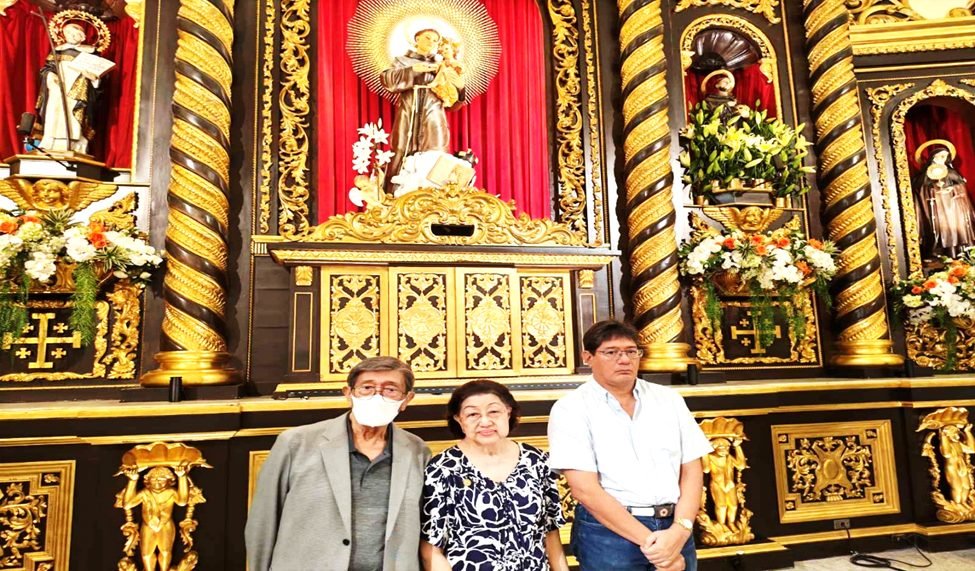
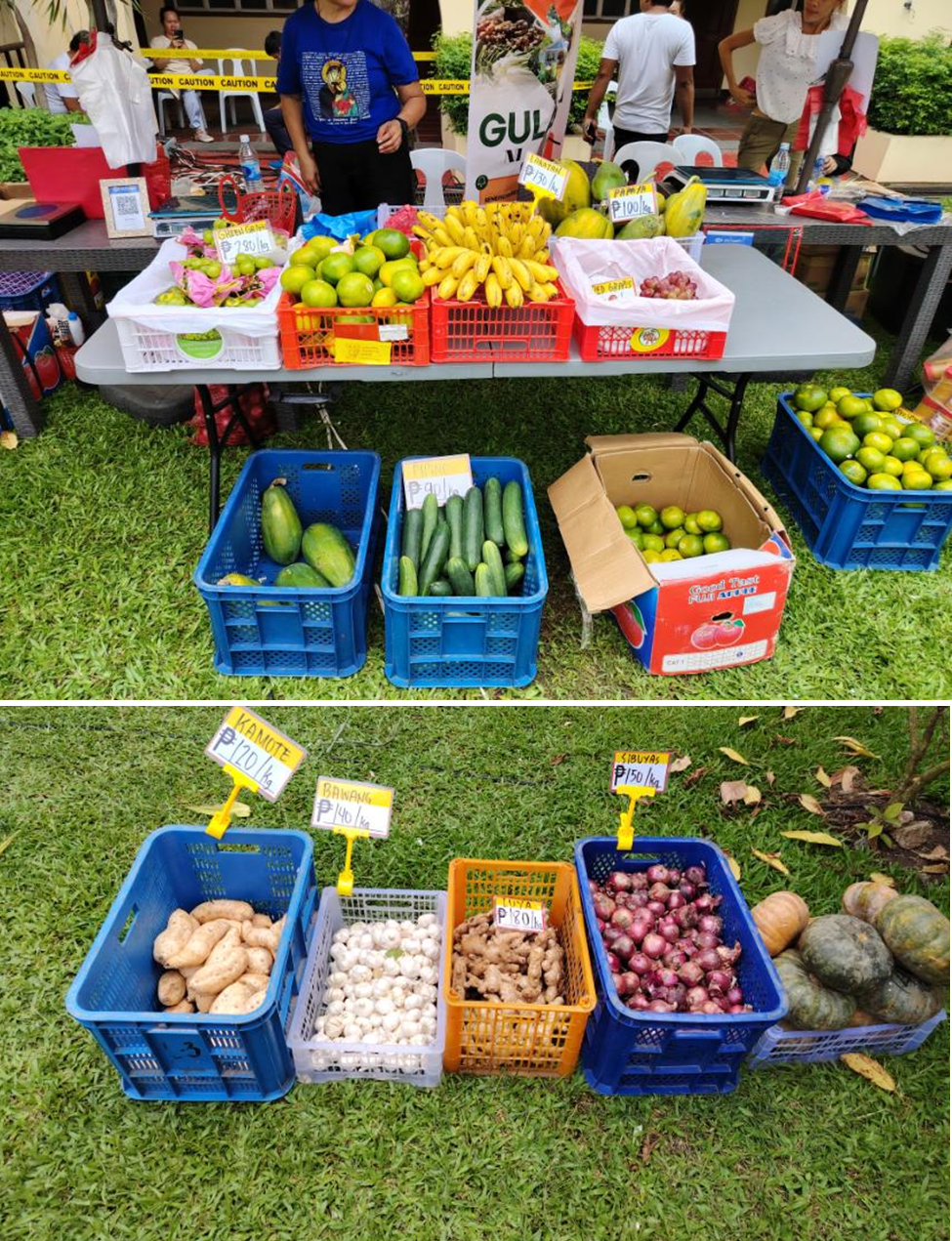
After Mass, visit to the St. Francis Fair Bazaar, SSAP Quadragal.


“The evil that men do lives after them; The good is oft interred with their bones.” (Shakespeare).
Business Enterprises are not Legacy: the wake you leave, let the Montinola Cumagun Care Foundation’s Good Work speak, not our family name.
One phrase in the Gospel (Good News) sounds familiar: “I will follow you, Lord, but first…” (Luke 9:57-62). Notice: the man did not say, “Lord, I will not follow you.” He wanted to follow Jesus. The problem was the words: “But first…” And perhaps that is also our children’s struggle to wholeheartedly support the Montinola Cumagun Care Foundation. We all love God; so do our children – we want to become better. We want to pray more, change our ways, serve others, and sacrifice even a widow’s mite and for public consumption more, but not yet! (Adapted from Repost Maruja Paredes)
Our Lady of the Impossible, grace those late in life but had more in life who tried to be their brothers’ keepers for those who have less in life – “Ester and I pray for your blessings to grace our children, and their children’s children, to wholeheartedly support The MCC FOUNDATION – The MONTINOLA-CUMAGUN CARE FOUNDATION OBJECTIVES: (1) Special Children SPED, “A child’s mind is the most precious thing to waste.” (The motto of the American Negro College), and the Handicapped Senior Citizens – Physical Therapy. (2) Financial Support for Diocesan priests and Grade School Teachers for the rural areas. (3) Computer Start-up Education Tools for selected public schools and (4) Selected Start-up Management and Financial Support for Small Businesses. “From everyone who has been given much, much will be demanded; and from the one who has been entrusted with much, much more will be asked.” Luke 12:48. “The sin of the rich man was not that he did wrong things, but that he did nothing.” (William Barclay, in Antonio G. Cumagun Autobiography Song of Myself Memoirs, Looking Back at Serendipity, 2002) Our Lady of the Impossible, “Remember, O most gracious Virgin Mary, that never was it known that anyone who fled to thy protection was left unaided…” Bless the good news of peace and justice through Ester and my founding the Montinola Cumagun Care Foundation.
Ester and My State of Health
(Vital stats of Ester and Tony C are recorded every day by 24 hr. PDNs.)
Ester’s morning BP was 110/70. HR 60. O2sat 98%. Temp. 36
Last Night’s BP was 10 /80. HR 73. O2sat 97%. Temp 36. 4
Tony’s morning BP was 120/70. HR 60. O2sat 98%. Temp. 36.7
Last Night’s BP 110 /70. HR 59. O2sat 99%. Temp. 36.7
Beata John Paul 1, watch over Cristina C, Justice Jun’s state of health, Ester’s recovery, and our autistic son John Paul’s emotional stability 57. Johnny Ong’s youngest son, Richard, is diagnosed with blood cancer.
FOR THE FAITHFUL DEPARTED AND SOULS IN PURGATORY
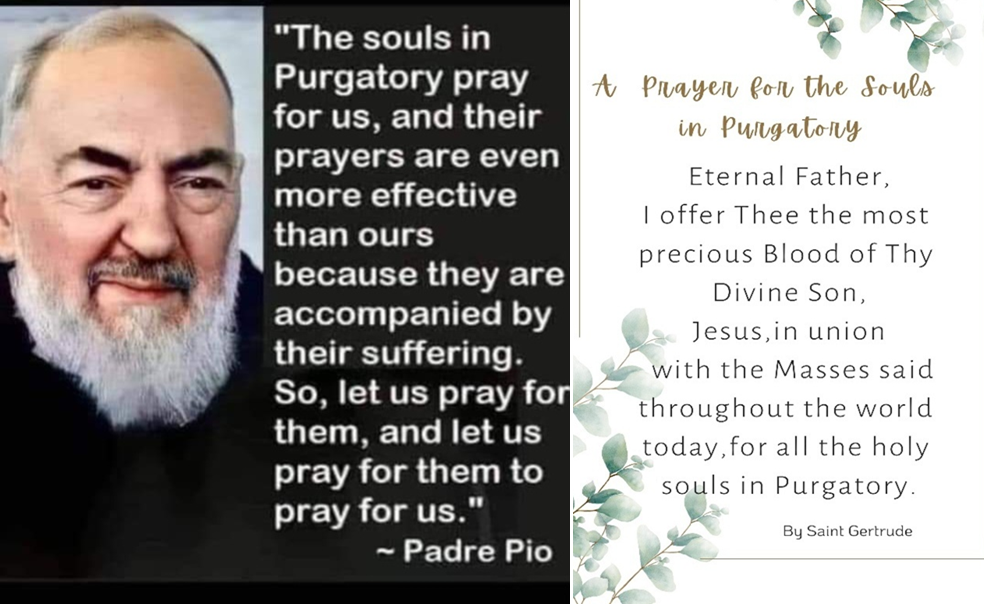
In Memory of all those who left us. We remember you in the morning and at night. You are always with us. We pray for the souls in Purgatory.
Blessed Mother Mary, I bring to you for your intercession the souls of Amb. Manuel R. and Dolores G. Cumagun, Juana Cumagun, Annette Cumagun, Lina Beltran, Judge and Mrs. Dolores Cumagun, Gov. Primo & Magdalena H. Gaffud, Dr. Trino, Sr. & Angeles Montinola, Betty, Luie, Trino, Jr. Montinola, Bernardino, and Isabel Jalandoni. Dr. Terry Lirio-Montinola, Dr. & Mrs. Tomacruz, Akira Tsusaka, Boy Eugenio, Jesus Ibañez, Sen. Nene Pimentel, Santiago Ranada 111, Boysie Villavicensio, Patria Manuel, Dr. Mariano Laurel, Rene Datu, (Ateneo ’54 – Jimmy Ongpin, Atty. Ato Gonzales, Buddy Joaquin, Fr. Unson, Msgr. Tantoco, Atty. Art Alafriz, Robert Arevalo Ylagan, Maximo Abesamis, Jr., Jesse Paredes), Atty. C. Platon, Araceli Rivera, Rey Castañeda, Col. Tanseco, Dr. E Fores, Dr. J. Caedo, Christine Syjuco, Leni Panganiban, Raul Boncan, Atty. Spanky and Dolly Perez, Amb. Albert del Rosario, Nellie Valdez, Toti Herbosa, Tec Syjuco, AL, Umberto (Beck) Gonzales, and Rufo Colayco. Pray 7 Our Father and The Credo